Key takeaway: A co-located site is a battery, a solar farm, a wind farm or any combination of the three behind one connection point. The assets share the site's export limit, and the dispatch model optimises them together in each 5-minute interval to maximise total site revenue.
This page sets out how co-located sites are modelled in the National Electricity Market (NEM): the supported configurations, the generation profiles, coupling and conversion losses, and the export modes. Background is available in Modo Energy research: Co-location and battery energy storage explained.
Site configurations
Seven site configurations are supported:
- One asset: battery only, solar only or wind only.
- Two assets: solar and battery, wind and battery, or wind and solar.
- Three assets: wind, solar and battery.
Contracts can be attached to solar but not to wind.
Dispatch of a co-located site
The dispatch model chooses the most profitable use of the site in each 5-minute interval:
- Direct export: sell solar or wind at the spot price.
- Generation to battery: store solar or wind for sale at higher prices, subject to the conversion losses on that path.
- Battery arbitrage: charge the battery from the grid and discharge it to capture price spreads.
- Curtailment: reduce generation when export revenue is negative or the export limit is reached.
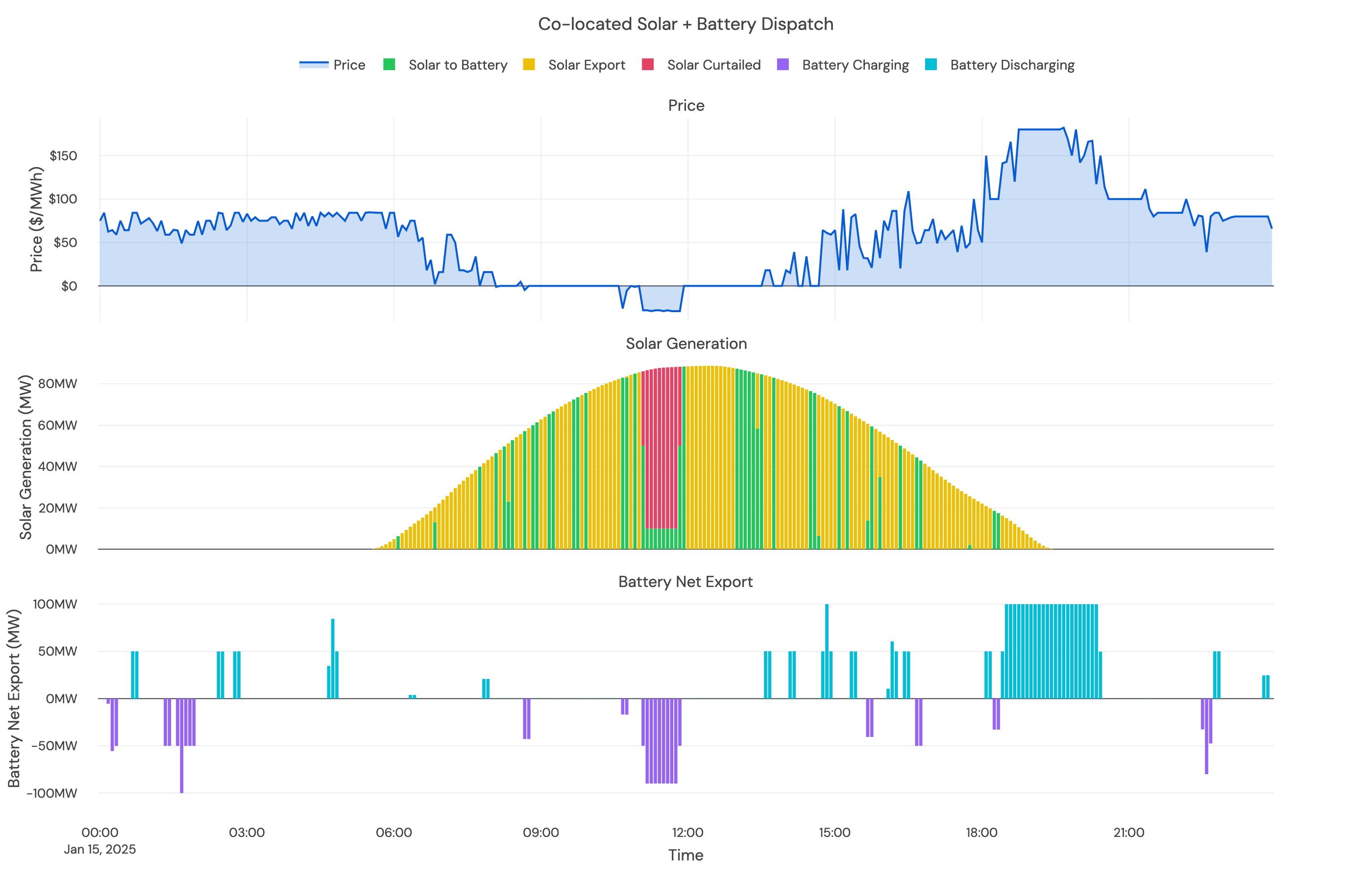
Solar and wind both earn Large-scale Generation Certificates (LGCs) on the energy they export or send to the battery. The chart shows an example day in a solar-battery hybrid: solar is exported, stored or curtailed as prices move, and the battery discharges into the evening peak.
Solar profiles
Solar profiles are generated from the ERA-5 climate database for the synthetic reference year, consistent with the fundamentals model (see Reference Years). The key inputs are:
- Co-ordinates: the site location.
- Azimuth: the direction the panels face.
- Tilt: the panel angle from horizontal.
- Tracking type: single-axis tracking (SAT).
A customer-uploaded profile can be used instead of the modelled one. It is taken as the site’s output at the connection point.
Wind profiles
A wind farm takes a nameplate capacity between 1 megawatt (MW) and 1,000 MW and an optional uploaded generation profile.
By default, the profile is the Australian Energy Market Operator (AEMO) wind trace for the Renewable Energy Zone (REZ) nearest the site, within the site’s own state. AEMO models two traces for each REZ, one for its high-quality wind resource and one for its medium-quality resource. The site profile uses the high-quality trace.
The trace is stitched month by month into the synthetic reference year, using the same month-to-year mapping as the fundamentals model (see Reference Years). The resulting year is applied to every forecast year.
A customer-uploaded profile is taken as the wind farm’s output at the connection point, and is also mapped onto the reference year. The wind farm keeps its annual output and its mix of windy and calm days, while the timing of those days follows the REZ trace for the reference year.
Coupling and conversion losses
Modelled solar exports through its inverter and the site’s alternating current (AC) stage, which covers the transformer and the connection. This applies on every configuration, including a solar-only site. The battery set-ups are as follows:
- AC-coupled: solar or wind and the battery each have their own inverter and meet on the site’s AC bus, and AEMO requires them to register as two dispatchable unit identifiers (DUIDs) with sub-meters. Generation sent to the battery skips the AC stage and crosses the battery power conversion system (PCS) instead, whichever profile it comes from.
- Standard DC-coupled: solar and battery share one DC bus and one inverter as a single DUID, with a DC-DC converter on the battery’s path. Solar export crosses the shared inverter and the AC stage. Solar to battery crosses only the DC-DC converter, which the battery’s grid path crosses in both directions.
- Reverse DC-coupled: the DC-DC converter sits on the solar’s path, so every unit of solar pays it once. Solar export then crosses the shared inverter and the AC stage, while solar to battery crosses nothing more.
The export limit applies at the connection point. On DC-coupled sites, solar above the export limit can charge the battery from the shared DC bus, while on AC-coupled sites it is curtailed.

Export modes
Solar has three export modes, which decide whether unclipped solar can charge an AC-coupled battery:
- Optimise with battery (default): no rule forces or blocks solar charging, and the dispatch weighs the conversion losses on the solar-to-battery path against prices.
- Always export: all unclipped solar is exported, and an AC-coupled battery charges only from the grid.
- Export when prices are positive: solar is exported whenever prices are zero or above, and may charge the battery or be curtailed when prices are negative.
The modes are described in full under Solar Export Strategies.
Wind has no export mode setting and always runs on the equivalent of “Optimise with battery”. On a site with both wind and solar, each profile is clipped against the full export limit, and the optimiser shares the limit between them on value.