The Modo Energy European power price forecast models 15 bidding zones out to 2060, generating 15-minute prices for energy and ancillary services. See our backtest results for validation.
Three interconnected models
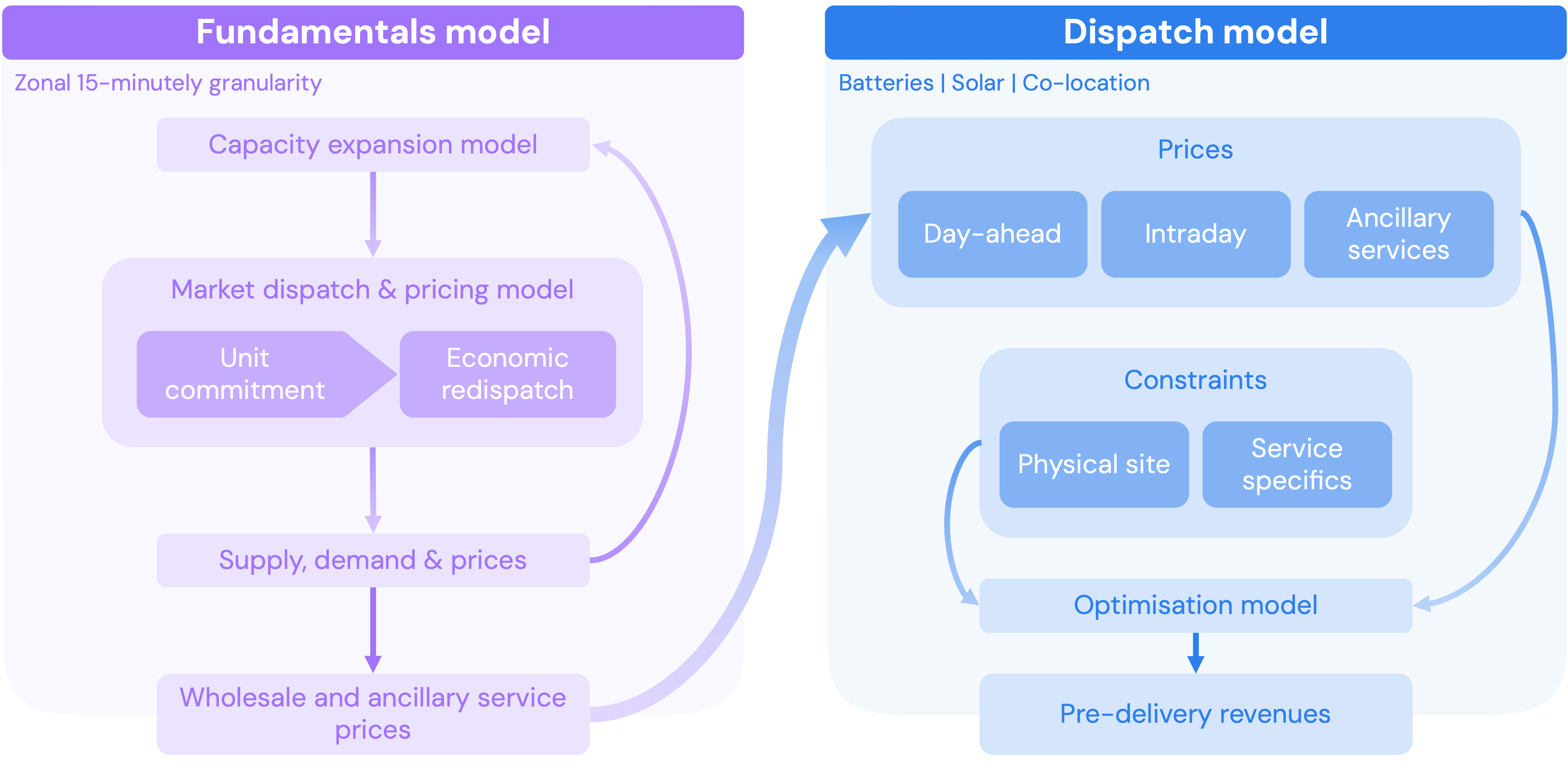
1. Capacity Expansion Model
Models which power plants will be built, retired, or re-powered in the future—and when. Uses economic optimisation, technology competition, and rolling window planning across 15 regional bidding zones with EU-specific policies.
| Core Concepts | Europe Implementation |
|---|---|
| How CEM works | Europe CEM assumptions |
2. Fundamentals Model
Generates energy and ancillary services prices for the spot market (day-ahead and intraday). Uses supply stack modelling, unit commitment, and merit order dispatch at 15-minute granularity with zonal pricing.
| Core Concepts | Europe Implementation |
|---|---|
| Production Cost Model | See components in next pages |
Core inputs
The model uses Modo Energy’s independently developed market outlook, informed by data from BNetZa, ENTSO-E, ESIOS, NESO, and NREL.
| Category | Key input sources |
|---|---|
| Demand | ENTSO-E’s TYNDP 2024 and ERAA 2024, NESO’s FES 2025 |
| Generation capacity | BNetZa, ENTSO-E, individual TSOs |
| Interconnectors | ENTSO-E |
| Commodity prices | Verified 3rd Party, Deloitte, IEA, Modo Energy, Oxford Economics |
| Renewable load factors | ENTSO-E, Renewables Ninja |
| Thermal generators outages | ENTSO-E |
| CapEx and OpEx | Modo Energy’s GB CapEx survey, NREL ATB 2024 |
3. Dispatch Model
Uses mixed integer linear programming to co-optimise battery, solar, and co-located asset dispatch into energy and ancillary services markets.
| Core Concepts | Europe Implementation |
|---|---|
| Dispatch Model overview | Great Britain, Germany |
Integrated regional modelling
To reflect highly interconnected dynamics within the European Electricity Market, we model 15 different regions. A region is defined as a country or a combination of countries that make a bidding zone (namely, Germany and Luxembourg).
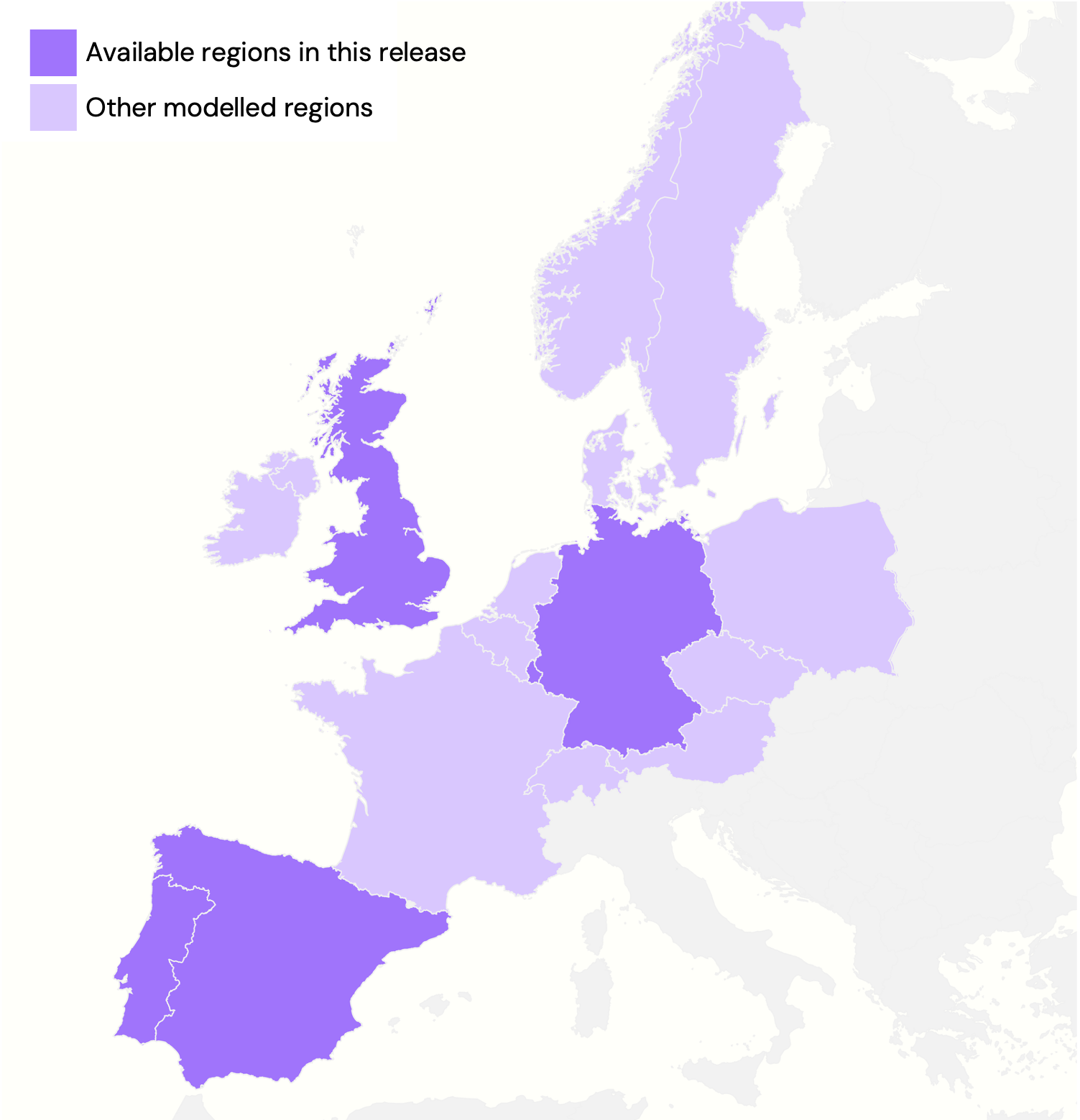
For country-specific methodology and assumptions, see:
- Great Britain — Dispatch model, network charges, Balancing Mechanism
- Germany — German market structure and dispatch considerations
15-minute prices
The model runs at 15-minutely granularity to build a full time series of electricity and ancillary services prices through to the end of the model. Modelling at 15-minute granularity is critical to maximise the value that battery energy storage can capture from volatility and both day-ahead and intraday markets.
This time granularity aligns with European wholesale power markets, after the day-ahead market moved from hourly to 15-minute trading intervals on 30th September 2025.
The chart below is interactive—hover over data points to see exact values.
Explore the fundamental model’s components
Demand
How we forecast electricity demand across European markets
Generation
Generation capacity assumptions and forecasting methodology
Storage
Energy storage modeling and market participation
Interconnection
Cross-border transmission and market coupling
Ancillary Services
Frequency response, reserves, and system services
Day-Ahead vs Intraday
Understanding the different European power markets
Backtest
Historical accuracy and model validation