Overview of revenue streams available to battery storage in the German market
Available Markets
In Germany, battery storage assets can participate in the following revenue streams:
Energy Markets
| Market | Granularity | Description |
|---|---|---|
| Day-ahead | 15-minute | Main wholesale market cleared day before delivery |
| Intraday Auctions and Continuous Market | 15-minute | Continuous trading up to 5 minutes before delivery |
Ancillary Services
| Service | Product Duration | Procurement | Description |
|---|---|---|---|
| FCR | 4-hour blocks | Day-ahead | Primary frequency control with symmetric provision |
| aFRR Capacity | 4-hour blocks | Day-ahead | Secondary frequency control capacity reservation |
| aFRR Energy | 15-minute | Real-time | Energy payments for activated aFRR |
| Inertia (Momentanreserve) | 10-year contract | TSO published prices (2-10 year contracts from 2026-27) | Synthetic inertia from grid-forming, inertia-ready inverters with overload capability |
More information on these below.
Day-ahead Market
The day-ahead market is the primary wholesale market where most energy is traded. Key characteristics:
- 15-minute granularity – finer resolution than hourly markets in other countries
- Single clearing – market clears once per day for all delivery periods
- Pay-as-cleared – all accepted bids receive the marginal clearing price
Batteries participate by offering to charge during low-price periods and discharge during high-price periods, capturing the spread.
Intraday Market
The intraday market allows participants to adjust positions after the day-ahead market closes:
- Continuous trading – trades executed as matched, not in discrete auctions
- Gate closure – 5 minutes before delivery (one of Europe’s shortest)
- Price volatility – prices can deviate significantly from day-ahead as forecasts update
This market is increasingly important for batteries as renewable forecast errors create trading opportunities close to real-time.
How much of it a battery can use depends on its size. Larger assets can retrade less of their power as the addressable pool per MW of flexible fleet shrinks. See Intraday Market Saturation and Liquidity Awareness. A schedule freeze can also stop the battery changing its position in the hours before delivery.
Frequency Response Services
Frequency Containment Reserve (FCR)
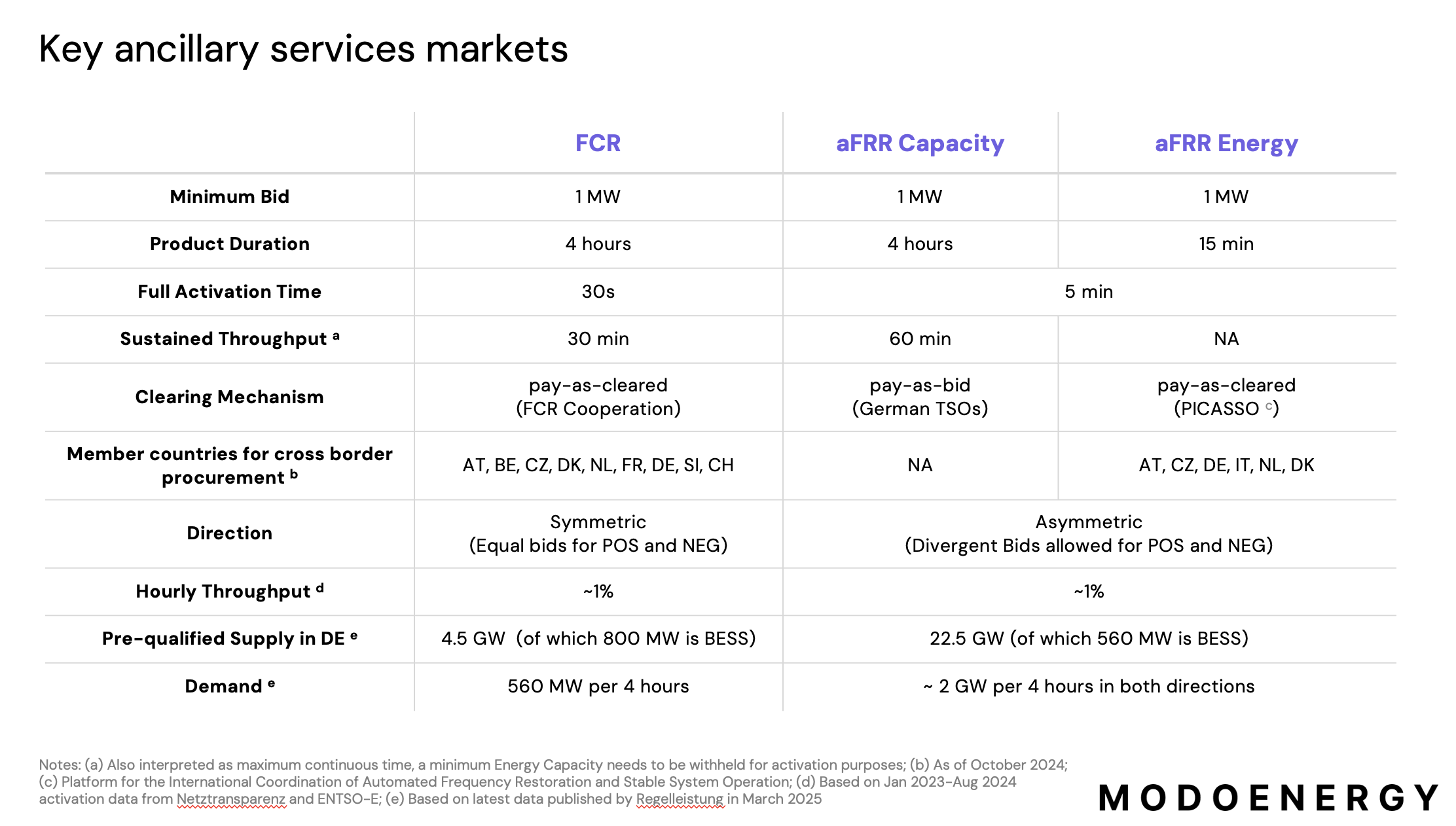
FCR is the fastest-responding frequency service, activated automatically when grid frequency deviates from 50 Hz:
- Symmetric provision – equal capacity must be offered in both directions (charge and discharge)
- 4-hour blocks – capacity contracted in 4-hour windows
- Cross-border procurement – traded through the FCR Cooperation platform with AT, BE, CZ, DK, NL, FR, SI, CH
- Pay-as-cleared – marginal pricing through the cooperation
- Full activation time – 30 seconds
- Minimum bid – 1 MW
Automatic Frequency Restoration Reserve (aFRR)
aFRR is secondary frequency control that restores frequency after FCR activation:
- Asymmetric products – separate positive (upward) and negative (downward) capacity
- 4-hour blocks – capacity contracted day-ahead
- Pay-as-bid – capacity payments at bid price (German TSO procurement)
- Full activation time – 5 minutes
- Minimum bid – 1 MW
aFRR Energy Activation
When aFRR capacity is called upon, energy payments are made separately:
- 15-minute granularity – energy settled at quarter-hour resolution
- Pay-as-cleared – through the PICASSO platform (AT, CZ, DE, IT, NL, DK)
- Real-time procurement – activated based on system needs
Inertia (Momentanreserve) is contracted under TSO published prices for inertia-ready inverters
Inertia (Momentanreserve) is procured by the German TSOs through published prices for 2 to 10-year contracts, with delivery starting in the 2026-27 period. The product remunerates inertia-ready inverters that can deliver synthetic inertia to the system through their overload capability.
- Contract length used in the model: ten years, the upper end of the published 2 to 10-year contract range
- Eligible capability: only inertia-ready inverters with overload capability - inverters that can briefly exceed the asset’s rated power for a few seconds - are assumed to qualify
- Committed volume: the full overload capability of the inverter is assumed to be committed to the inertia market; no dispatch headroom on the rated power of the asset is marketed as inertia
- Availability assumption: revenue is scaled by an assumed 95% availability, derived from operational unavailability data observed in Great Britain (no equivalent German dataset is currently available)
Inertia revenue is reported separately in results and is not co-optimized with energy or other ancillary services, as it is contracted upfront for the full ten-year horizon.
To enable inertia revenue in a forecast run, the Grid-forming inverter toggle on the Battery tab of the forecast creation flow must be turned on, and a value above 0% entered into the Inverter Overload Capacity field. See the Dispatch Model page for the corresponding input fields and a worked example.
Key Market Parameters
Related Pages
- Dispatch Model – How the model optimizes across these revenue streams
- Capacity Expansion Model – Projected BESS buildout in Germany