Our NEM forecast is a 5-minute granularity, substate zonal model up to 2050. The forecast models demand, generation, constraints and ultimately prices at a 5-minute settlement period level, which in turn are used as inputs to our battery dispatch model.
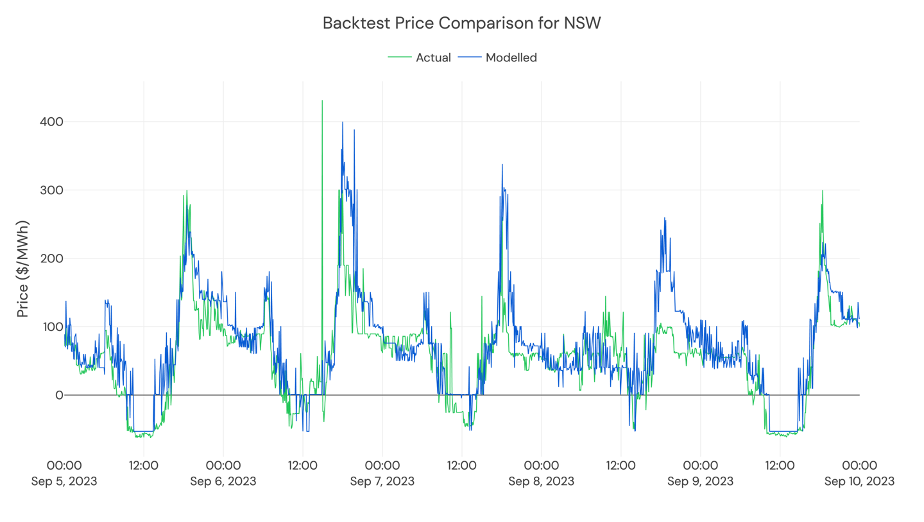
The model runs off assumptions of demand, generation capacities, storage capacities, bidding behaviour, transmission capacities, and outages. We have rigorously tuned our fundamentals model against historical prices to accurately reflect actual price-setting behaviour. We specifically focus on properly modelling periods of volatility, as those periods are especially important to storage revenues.
Substate-level modelling
To reflect regional dynamics within the NEM, we model at the substate level and consider transmission limits between substates. We divide the five NEM states into nine distinct regions, based on ISP Subregions:
- North, Central, and South Queensland
- North, Central, and South New South Wales
- Victoria
- South Australia
- Tasmania
5-minutely pricing
The model runs at 5-minutely granularity to build a full 5-minute time series of energy and FCAS prices through to the end of the model. Modelling at 5-minute granularity is critical to capturing some of the main drivers of price volatility within the NEM, as well as maximising the value that battery energy storage can capture from this.
What are the core inputs?
The model uses a range of inputs, primarily Modo Energy’s independently developed market outlook. This is informed by other sources, including data from NEMWEB, the 2024 AEMO Integrated System Plan (ISP), and ISP updates from the Draft 2025 Stage 2 Inputs and Assumptions. This outlook is grounded in rigorous market research and informed by deep industry expertise, providing a nuanced view of the future electricity market and capacity landscape. Find out more information by heading to the sub-page for each section.
| Category | Key input sources |
|---|---|
| Demand | AEMO 2024 ISP Demand traces, AEMO 2024 Electricity Statement of Opportunities (ESOO), AEMO MMS, NEMWEB |
| Generation | AEMO 2024 ISP, AEMO 2025 IASR, AEMO April 2025 Generation Information, AEMO MMS |
| Transmission | AEMO 2024 ISP, AEMO Network outage detail |
| Commodity prices | AEMO 2025 IASR, AEMO Daily STTM reports, AEMO DWGM Victorian Wholesale Price, ASX Gas and Coal Futures |
| Renewable load factors | AEMO 2024 ISP, AEMO 2025 IASR, AEMO MMS |
| Marginal loss factors | AEMO Marginal Loss Factors |
| Community energy resources | AEMO 2024 ISP, Clean Energy Regulator, NEMWEB |
| CapEx and OpEx | CSIRO GenCost 2024/25 |
Volatility
How we model price volatility in the NEM
Weather Years
Weather year selection and renewable generation profiles
Unit Commitment Model
Generator commitment and dispatch optimization
Demand
Electricity demand forecasting and assumptions
Generation and Storage
Generation capacity buildout and storage modeling
Transmission
Transmission network constraints and flows
FCAS
Frequency Control Ancillary Services modeling
FCAS Islanding
Modeling FCAS requirements during islanding events
Scenario Modelling
Different market scenarios and sensitivities
Administered Pricing
How we model administered price caps and interventions
Backtest
Model validation against historical data