This page covers co-located sites, where a renewable generator shares a grid connection with a battery. It also extends to tri-located sites, where solar, wind, and a battery all sit behind the same connection.
The examples below use solar, but wind is co-located in the same way. Like solar, a co-located wind site can be AC- or DC-coupled, and the same optimisation logic applies. The main difference is that wind is dispatched in always export mode - see Wind for detail.
Let’s firstly consider the solar asset
Solar generation can be:
- Exported directly to the grid. We calculate solar revenues due to PV generation exports using the half-hourly wholesale power price.
- Used to charge up the battery. Rather than directly selling solar generation to make money, the battery can be used to ‘time shift’ the solar generation - ie charge up from the solar and discharge at a later (more profitable) time.
Operation - so our optimisation - depends on whether the site is AC or DC coupled.
AC and DC coupled sites have a different set up: more info here.
If the site is AC-coupled, any solar generation exceeding the inverter power is ‘clipped’ - it is dumped as heat. This happens when the solar is oversized compared to the grid connection. While some PV generation is lost, the overall load factor of the site is higher.
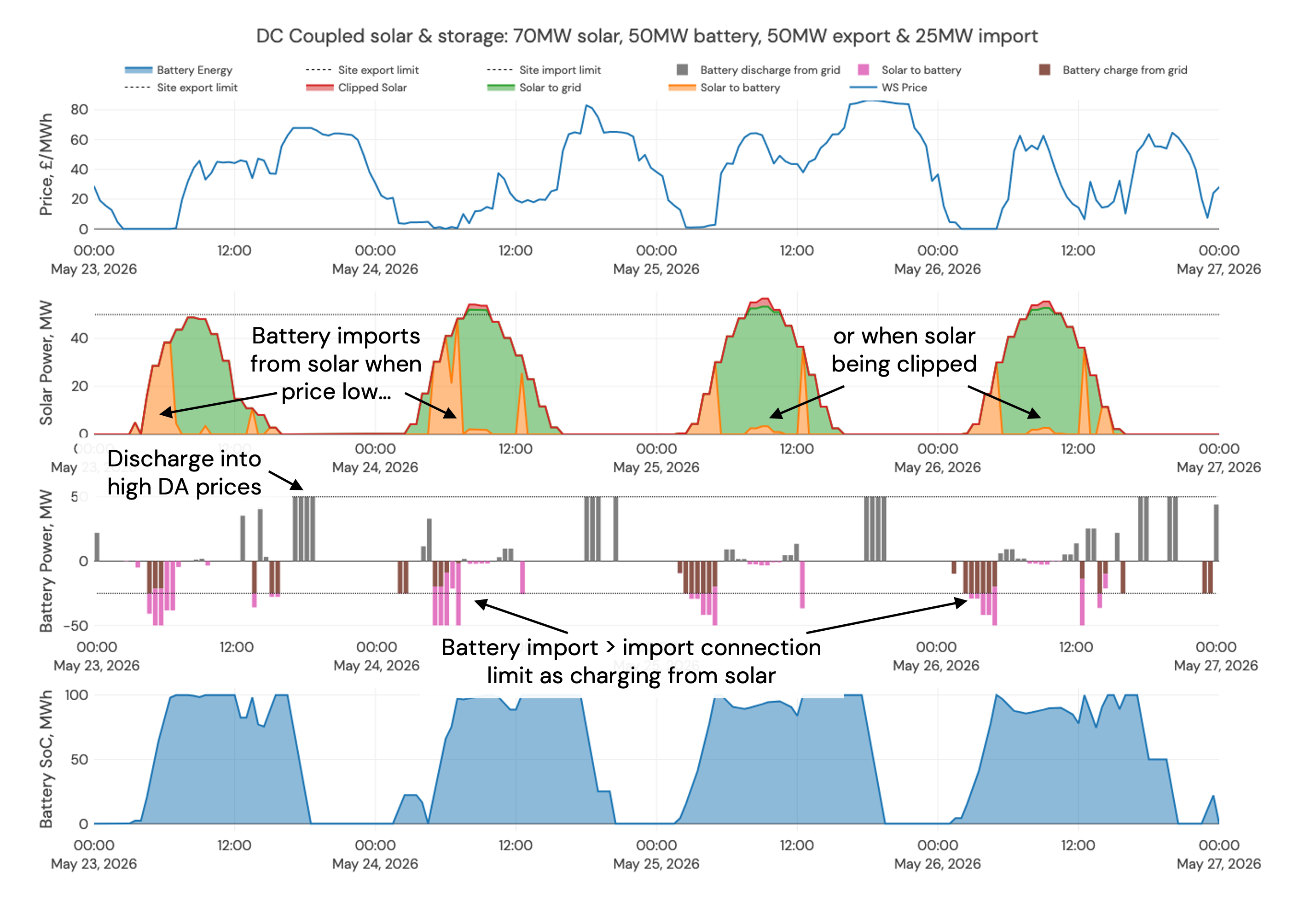
If it is DC-coupled any solar generation exceeding the inverter power can still be used to charge up the battery, that otherwise would have been wasted.
Wind works the same way. A co-located wind site is also either AC- or DC-coupled. On an AC-coupled site, wind generation above the inverter power is lost; on a DC-coupled site, that excess can charge the battery instead. Because wind runs in always export mode, wind is exported as it is produced rather than being time-shifted through the battery, but the coupling logic is identical.
On AC coupled sites, the battery looks more like a stand-alone site
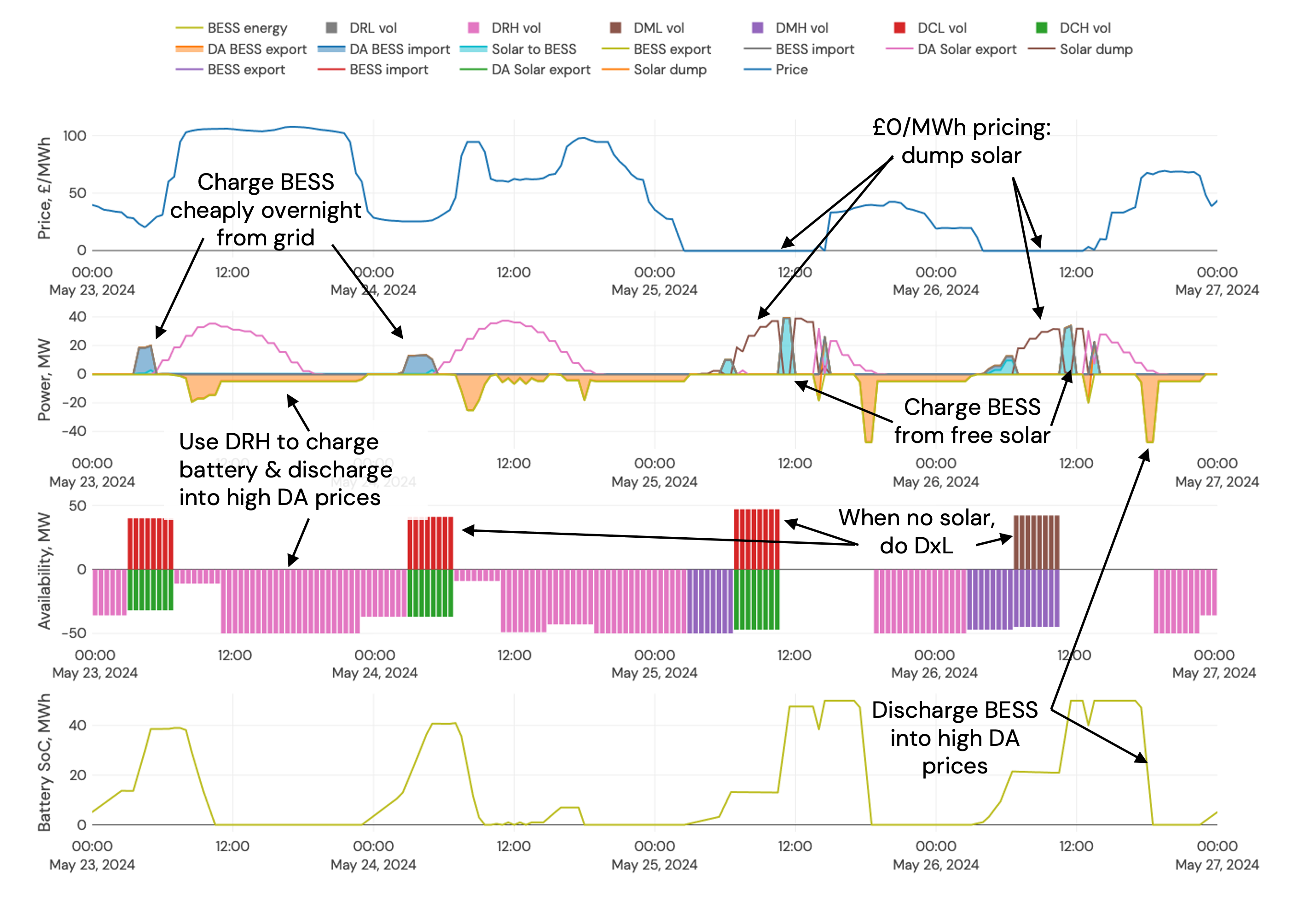
The battery runs independently of the solar asset on AC coupled sites: it can be optimized and dispatched in exactly the same way as for a standalone battery, only the sum of solar exported power and battery exported power must not exceed the grid connection.
- This looks a bit like a variable export connection, which has an inverted solar profile on it - assuming the the solar always takes priority (which is often the case)
- We do allow the battery to charge from solar power that would otherwise be dumped - particularly when power prices are £0/MWh
Example of merchant + ancillary optimisation for AC coupled co-located solar site
On DC-coupled sites, batteries can charge from clipped solar
Example of DC coupled optimisation, on a site where solar is oversized vs export connection with smaller import connection
We show the combination of generation and storage revenues in total revenue figures
The optimisation of the site is dependent on the wholesale power price in our forecast.
So, we do not differentiate between generation and battery revenues for co-located sites: as the operation of the assets are intrinsically coupled, therefore, so are revenues. This holds for tri-located solar, wind, and battery sites too.
Instead our forecast provides total revenues for the whole site combined.
If you’d like to quantify the uplift from the battery on its own, check out the run library for the similar standalone asset.