Key takeaway: The SNSW-CNSW transmission corridor is a critical congestion bottleneck in the NEM. The model applies detailed outage derating and special treatment to these lines, capturing the volatility and price impacts driven by constraints on this weak part of the grid.
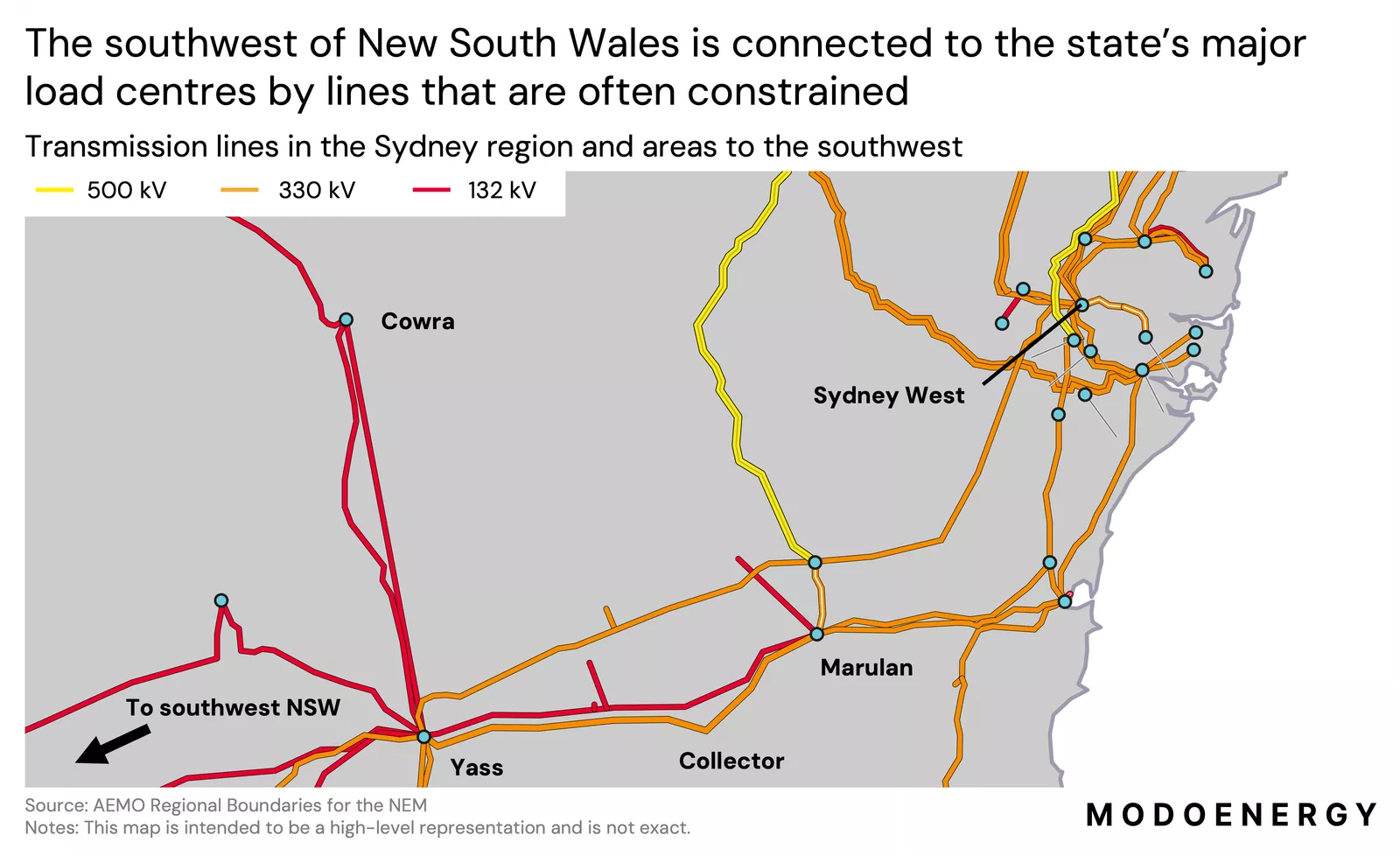
In addition to modelling traditional inter-state interconnectors, the framework treats select intra-state transmission lines that cross substate boundaries as functionally equivalent to interconnectors due to their significant role in regional power flow and price formation. These transmission paths - particularly those connecting high renewable zones with load centres - can materially impact local supply demand balances and price volatility.
A key focus area in the model is the Southern NSW (SNSW) to Central NSW (CNSW) transmission corridor. This cluster includes critical 330kV lines such as Collector to Marulan, Collector to Yass, and Yass to Marulan. This is a particularly weak part of the grid, and outages on these lines can cause significant transmission constraints and volatility.
Given their importance, the model applies extra care when representing availability on these links. Historical outage data is mapped to each line, then any periods of reduced availability are reflected appropriately in the modelled transmission between substates. This ensures the model captures the downstream impacts on dispatch outcomes and price volatility, especially during periods of high demand or high renewable output in affected zones.
Transmission augmentations
The model incorporates 32 planned transmission augmentations. These projects increase transfer capacity between NEM regions and substates over the forecast horizon, affecting price convergence and renewable energy delivery. Projects range from committed near-term builds through to longer-term planned investments, and are categorised by development status (committed and anticipated, actionable, and future).
Outage derating
Nominal transmission capacities for each corridor are sourced from AEMO data. The model then applies dynamic load factors to both inter-state interconnectors and intra-state transmission lines at each 5-minute interval to account for outages. These load factors represent the proportion of nominal capacity that is actually available, and are multiplied directly against the nominal rating to produce the effective transfer limit used in the optimisation.
For inter-state interconnectors, load factors are derived from AEMO dispatch data (DISPATCHINTERCONNECTORRES). The historical import and export limits reported by NEMDE are compared against nominal capacities to calculate the available proportion at each interval.
For intra-state transmission lines, outage records from NEMWEB’s public network outage dataset are mapped to specific transmission equipment and substations. When components are flagged as in outage, the corresponding load factor reduction is applied to the affected substate corridor. Where multiple lines are simultaneously in outage, the most restrictive load factor is used.
The SNSW-CNSW corridor receives additional treatment due to its importance as a congestion bottleneck. Planned outages on this corridor apply a maximum load factor of 0.5 (50% of nominal capacity) after the first day of outage. When HumeLink becomes operational, the minimum load factor on this corridor is set to 0.2, reflecting the additional redundancy provided by the new interconnector.
For new or future transmission infrastructure, the model synthesises outages by replicating and time-shifting patterns from similar existing assets. This creates realistic availability profiles for new lines that capture the variability observed in actual transmission outage patterns.
Outage data is aligned to the modelling period. In backtesting, actual historical outages are used. For forecasts, outages from a chosen “weather year” are shifted to match the target forecast period.