Key takeaway: Thermal retirements are based on Modo's house view, which is originally sourced from AEMO's NEM Generation Information dataset (January 2025) and adjusted based on operator announcements, government policy signals, and plant economics.
Cost of generation
Thermal generation is modelled by first calculating the short-run marginal cost (SRMC), i.e. what it costs each unit to generate. These SRMCs are calculated by multiplying each plant’s heat rate (a measure of thermal efficiency, typically in GJ/MWh) by their fuel price. Any additional variable maintenance costs are then added to capture the full cost of generation per MWh.
Adjustment for MLFs
In the NEM, while generators bid based on their SRMC, the NEM dispatch engine (NEMDE) accounts for network losses through Marginal Loss Factors (MLFs). Rather than adjusting the bid bands upon bidding in on the generator’s side, the NEM’s dispatch algorithm divides each generator’s bid price by its MLF to determine an effective cost at the Regional Reference Node (RRN). This means that, all else being equal, generators with lower MLFs (i.e., located further from the load or subject to higher losses) are less competitive in the dispatch process.
To reflect this behaviour, the model approximates the impact of MLFs by dividing each generator’s calculated SRMC by its MLF. This increases the apparent cost of generation for units with lower MLFs, ensuring that the model prioritises generation in locations with lower transmission losses - mirroring how NEMDE accounts for locational efficiency.
Representation of varied bidding behaviour
Although the SRMC of a unit gives a good estimate of roughly what that unit should bid, generators have varied bidding strategies in order to account for other factors such as ramp costs and start costs, minimum stable levels, profit maximisation of the unit, or profit maximisation of a wider generation portfolio. To capture this varied bidding behaviour, the historical bidding of each unit has been analysed in relation to their short-run marginal cost. Bids can in general be split into three categories:
The model distinguishes between three bid types by taking the historical bidding behaviour of each individual unit, and splitting their bids into bids below $-100/MWh, bids above 6% of the price cap, and bids in between. The graphs below demonstrate that these are three very distinct types of bid, with very little overlap.
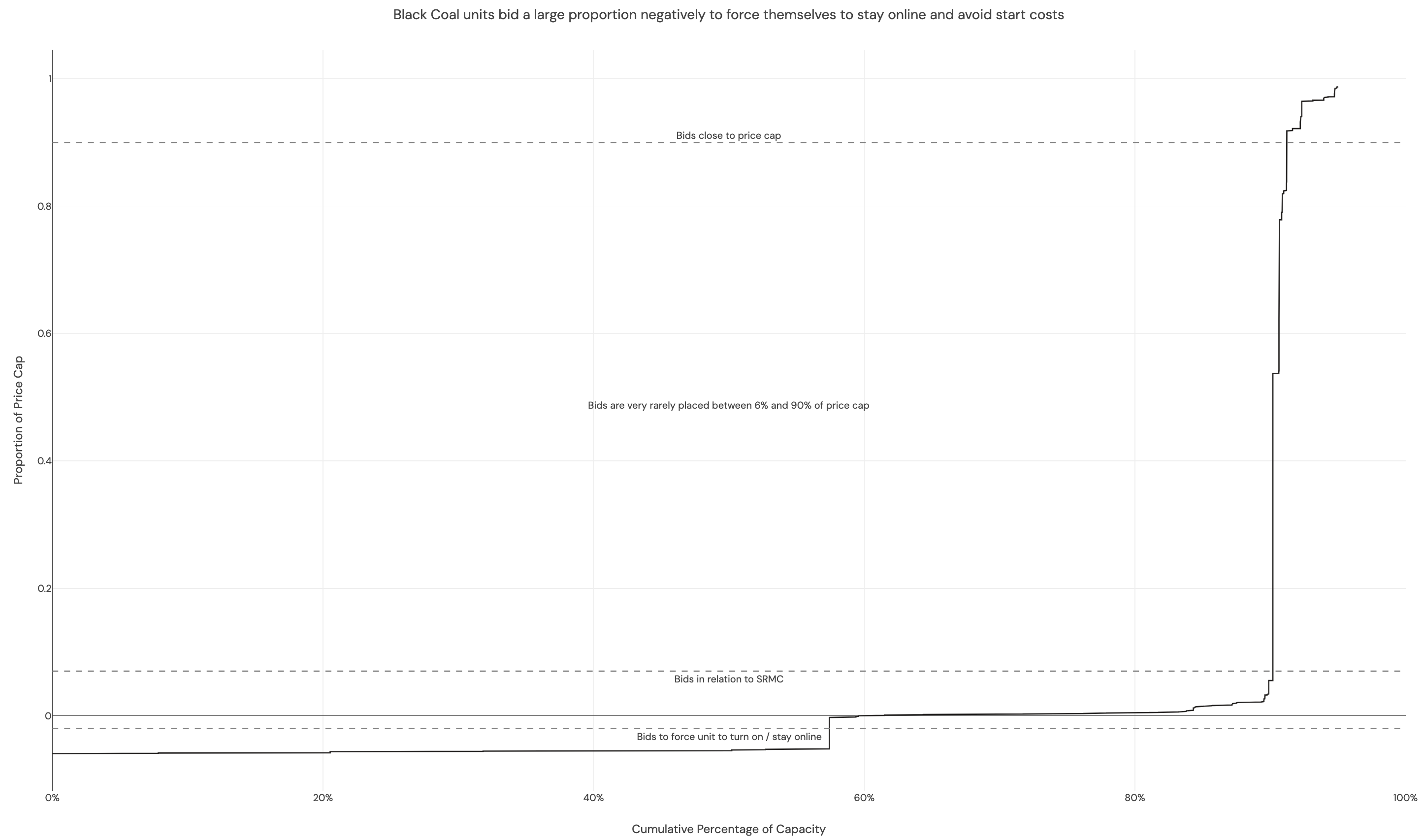
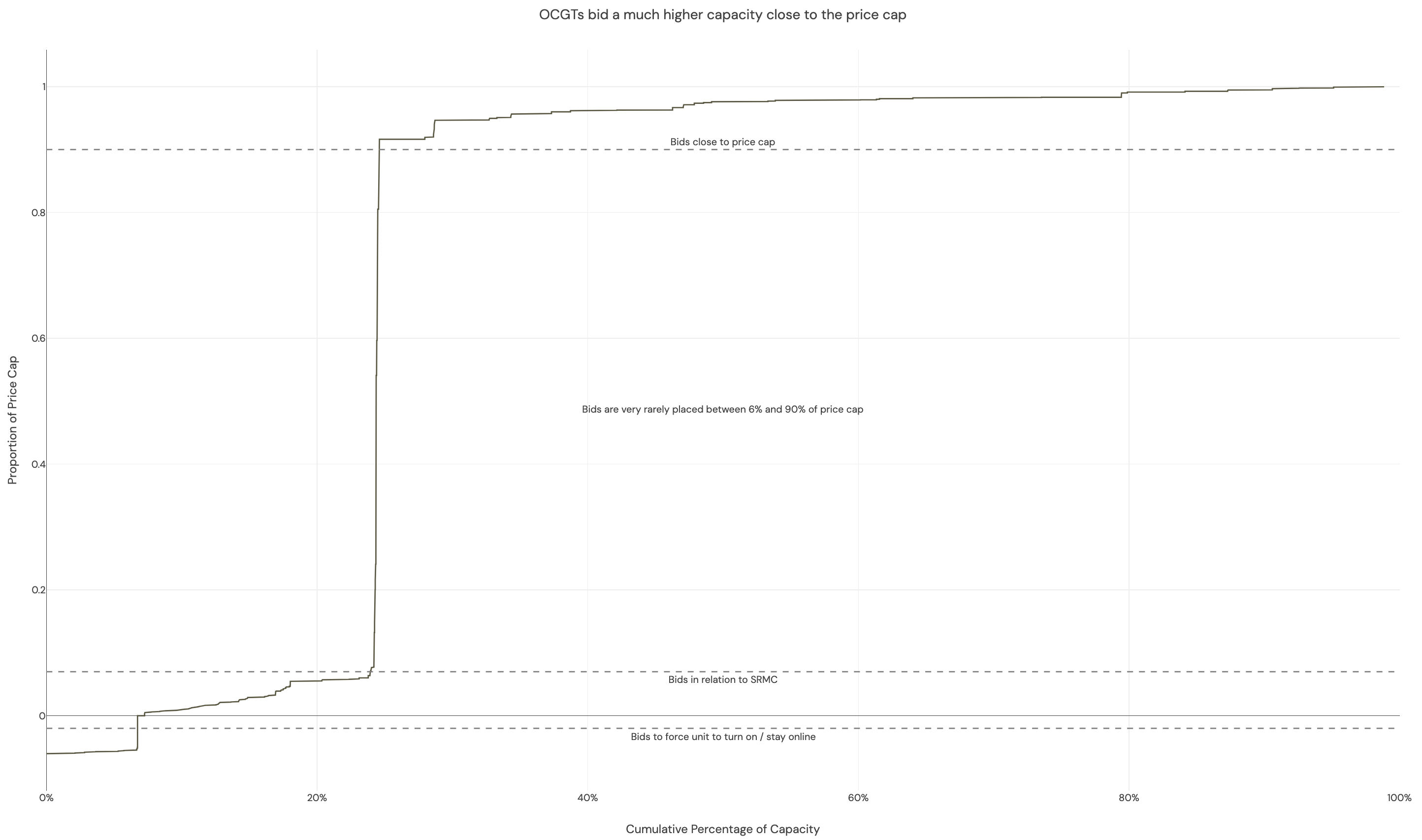
- Price Floor Bids: Bids below $-100/MWh ensure a unit generates above its minimum stable level. If a unit is determined to be ‘online’ by the unit commitment model, it must bid its minimum stable level negatively so that it definitely generates above that level.
- Price Cap Bids: Bids placed close to the price cap, usually for profit maximisation when system margin is tight. The proportion of each unit that bids close to the price cap requires careful calibration and has a significant impact on how often price spikes occur. This proportion cannot simply be taken from historical data, as units sometimes bid near the cap for other reasons. Often as system margin tightens, units actually start bidding more capacity closer to their SRMC. The proportion of generators that bid close to the price cap has been carefully tuned with extensive backtesting.
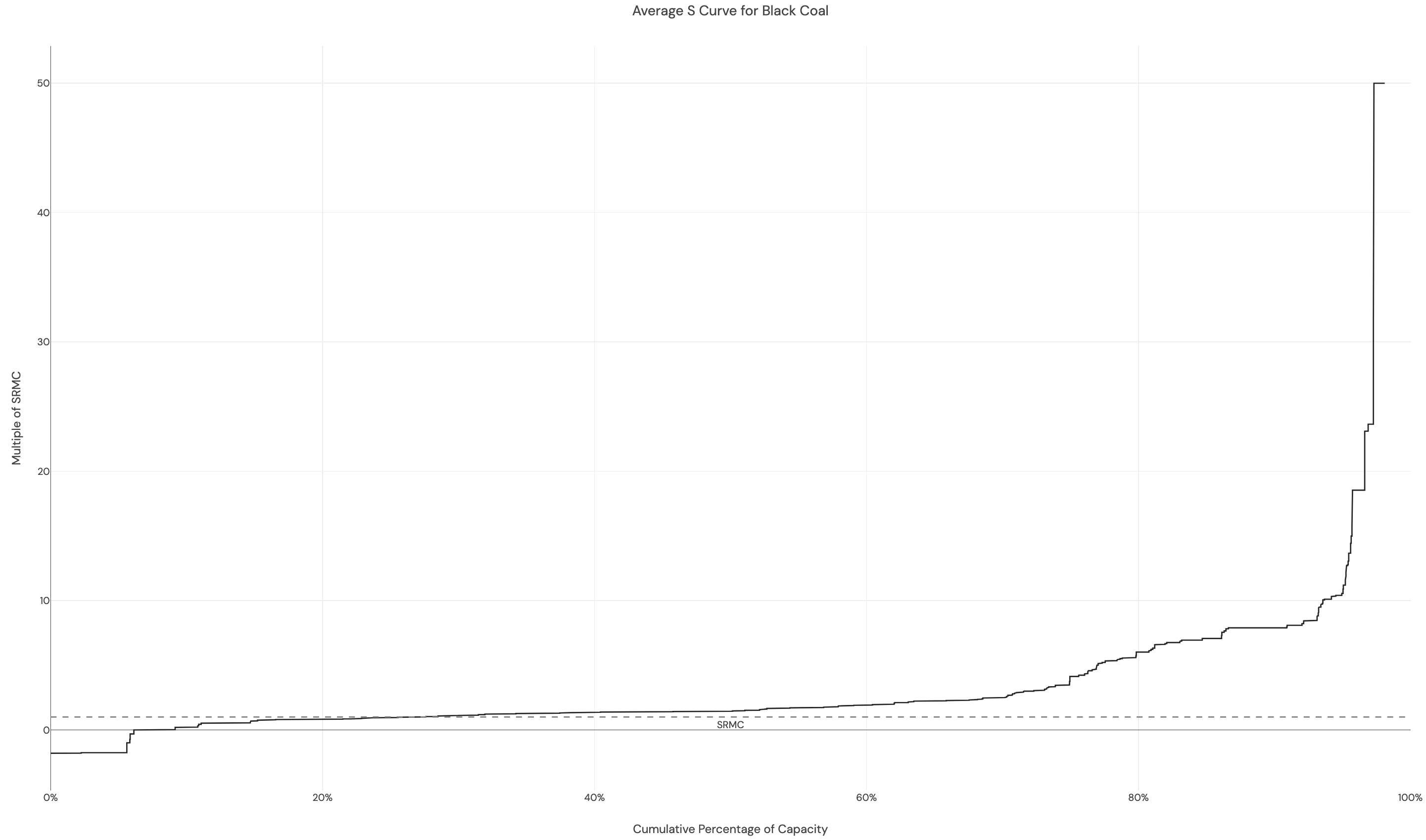
- SRMC Bids: The remaining proportion of each unit bids in relation to its short-run marginal cost. Historical bids from each unit that are not negative or close to the price cap have been isolated, and examined for how they are distributed as a proportion of their SRMC. This distribution (called an S curve) is then applied to the future SRMC of each unit. These S curves differ by unit, but below is the average bidding behaviour of black coal units.
Outages
The model calculates load factors to reflect the proportion of a thermal unit’s nameplate capacity expected to be available for dispatch at each interval.
For backtesting, actual availability data is used from AEMO’s DISPATCHLOAD data. For forecasting, outage patterns from a representative median weather year are time-shifted to align with the future forecast period.
For new thermal units with no operating history, the model simulates outages by sampling patterns from similar existing plants and applying random time shifts to introduce variation. These patterns are scaled to reflect the capacity of the new units, creating a realistic outage profile rather than simply extending historical averages.
Load factors are then applied to each unit’s nameplate capacity in the thermal supply stack to get the unit’s dispatchable capacity.
This approach ensures the dispatch simulation reflects the limited and variable availability of thermal units. Renewable generation, by contrast, is modelled separately using weather-driven profiles that capture resource specific variability. See Renewable Load Factors for more information.
Coal forced outage mechanism
Coal plant forced outages are modelled using a two-category approach based on unit status at the start of each optimisation window:
- Offline units: Units that are offline at the start of the day are treated as unavailable for the entire day. The UC model sees 0 MW for these units, preventing the model from starting up a plant that was already experiencing an outage.
- Running units: Units that are online have their UC capacity set to the daily maximum observed output. In the redispatch stage, a forced outage reduction is applied when a unit’s actual output in any interval falls below 50% of the daily maximum, representing partial forced outages that occur during operation.
This approach captures both full-day outages (where a unit never starts) and intra-day partial outages (where a running unit trips or derates during the day).
Thermal retirements
Thermal retirements are based on Modo’s house view, which is originally sourced from AEMO’s NEM Generation Information dataset (January 2025) and adjusted based on operator announcements, government policy signals, and plant economics.