Nodal Demand
Description
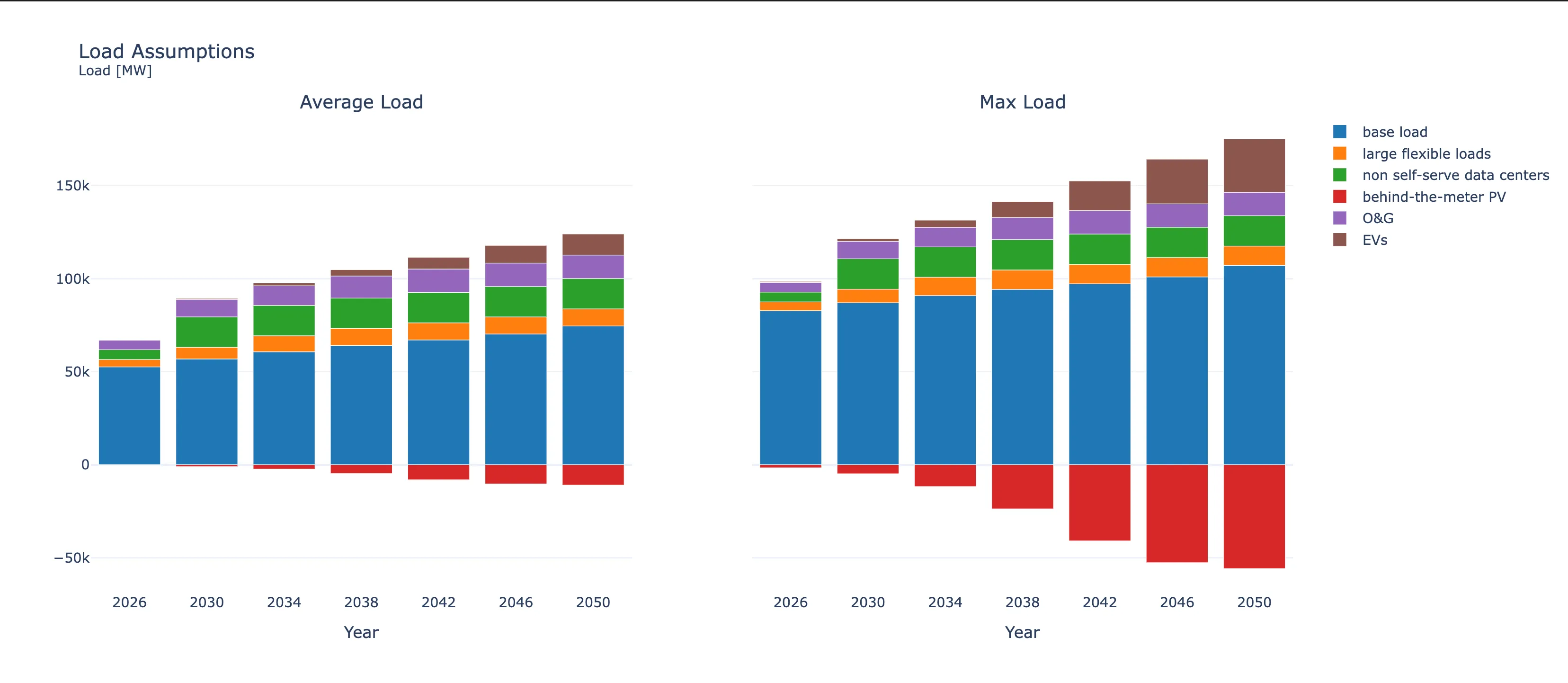
We model demand at the substation (node) level with hourly resolution to capture both intraday shape and seasonal effects. The primary input is ERCOT’s Long-Term Load Forecast (LTLF), which provides weather-zone hourly profiles through 2045 and separates demand into:
- Base (economic) load
- Behind-the-meter (BTM) rooftop PV
- Electric vehicles (EVs)
- Large flexible loads (LFLs)
- Large loads from Contracts & Officer Letters (hydrogen, data centers, crypto, oil & gas, industrial)
We use LTLF for Base, BTM PV, EV, and LFL. We do not take ERCOT’s Contracts & Officer Letters into our demand assumptions; instead, we apply Modo’s in-house bottom-up large-load build, informed by our research team. Oil & gas electrification assumptions are anchored to ERCOT’s Permian Basin Reliability Planning Study.
Central Case
Load profiles
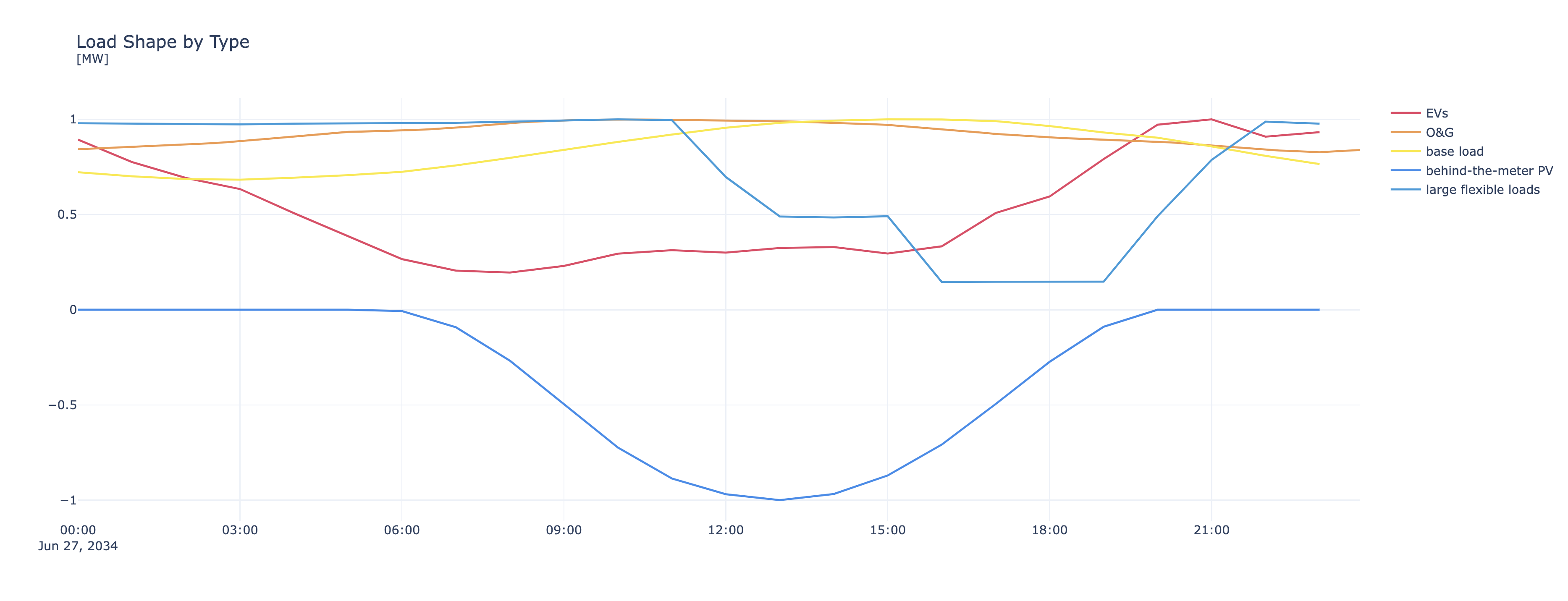
Each load component exhibits a different profile based on function, price responsiveness and any on-site behind-the-meter generation.
Representative large load profiles
Load Sensitivity
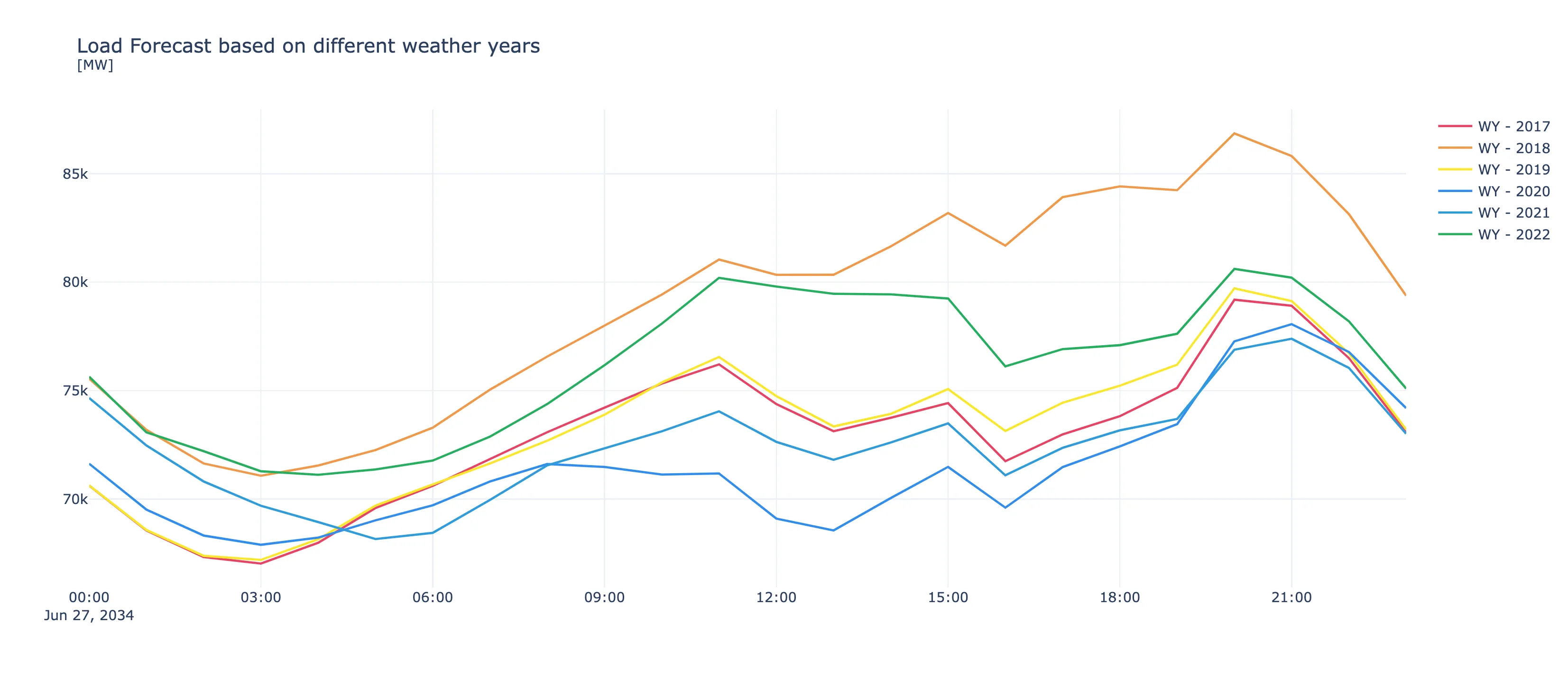
ERCOT’s LTLF timeseries data represents a “median” (p50) weather year using 2008 data. We extend this by enabling alternative weather-year load shapes to be layered on top of ERCOT’s values—supporting higher/lower demand cases and aligning the demand shapes with our renewable load-factor weather years for consistent scenario analysis.
Assumptions and Caveats
- Beyond 2034, demand growth is applied at the weather zone level, without explicit nodal detail.
Data Sources
| Source | Description | Link |
|---|---|---|
| ERCOT Long-Term Load Forecast | Provides weather zone hourly projections until 2045 | ERCOT LTLF |
| ERCOT Regional Transmission Plan (RTP) | Provides zonal to nodal distribution factors | ERCOT RTP |
| ERCOT Permian Basin Reliability Planning Study | Supports modeling of additional oil & gas-related load growth in West Texas | Permian Basin Study |
| Organization press releases | Used to identify additional large, non-O&G loads coming online. | - |